
Briefs
Field notes from the white space between functions.
Where value is created — and quietly lost — across manufacturers, distributors and healthcare operations. Each brief names one constraint, the function that pays for it, and what it costs.

Latest · Profit
The Whale Curve: The Business You're Growing That Doesn't Earn
Company-level margin is an average, and the average is the disguise. Resolve profitability to the customer and the SKU, with the true cost to serve attributed, and a third of the business is usually found to be destroying the profit the rest creates.

Throughput
Green Dashboards, Red Enterprise: The Cost of Local Optimization
Every function can hit its numbers while the enterprise misses its own. Value is created vertically, inside functions, and lost horizontally, in the handoffs between them, where no single owner is accountable for the interval.
Cash
One Matched Book: The Payables and Receivables Nobody Reconciled
Payment terms are negotiated on two sides of the house by people who never compare notes. Managed as one portfolio instead of two, the gap between what you pay and what you collect is a recoverable line, not a fact of life.
Cash
Self-Funded Transformation: Paying for the Program With What It Recovers
Most transformations fail, and most that stall do so over funding and a weak case for change, not technology. The capital to fund the work is usually already trapped inside the operation the work is meant to fix.
Cash
The Cost of Carry: Why Trapped Working Capital Stopped Being Free
Idle working capital used to be a rounding error on the balance sheet. At today's cost of capital it is a standing charge, and most of it is recoverable without a single dollar of new financing.
Throughput
The Batch Interval: How Scheduled Processing Cycles Set the Ceiling on Execution Velocity
Why the interval between forecast refresh, purchase release, and production scheduling caps throughput independently of physical capacity.
Profit
Contractual Value Erosion: Stacked Concessions and the Drift Between Signed Terms and Realized Price
Discount authority granted without a stacking cap does not erode price in one decision: it erodes it across an account's life, one reasonable concession at a time, until realized price sits below floor.
Profit
The Volume Discount Fallacy: Commercial Concessions Against Lot Sizes Production Never Runs
How volume-break pricing granted on projected order sizes converts a commercial courtesy into permanent unit-cost erosion, priced by sales and absorbed by operations.
Cash
The Dispute Resolution Gap: Deductions, Short-Pays, and the Unmeasured Cash Conversion Tail
Why the largest single line in the trapped-cash walk sits in collections, and how disputed invoices convert an operations error into a treasury liability.
Throughput
The Tier-Visibility Gap: You Can See Your Suppliers. You Cannot See Theirs.
A Tier-2 constraint reaches your assembly line as a surprise because visibility stops one level up. The delay was knowable weeks earlier by someone who had no reason to tell you.
Cash
The Working Capital Leak: Safety Stock Set Once and Never Revisited
Buffer levels were set against a demand profile that no longer exists, and nothing in the process forces them to be re-asked. The overstock is not a planning error. It is the absence of a planning cadence.
Profit
The B2B Friction Void: The Orders You Win and Then Make Hard to Place
Enterprise buyers abandon configured orders at a rate no one reports, because the abandonment happens inside a quoting cycle rather than a cart. The revenue is already won and then lost on the way to a contract.
Throughput
The Cognitive Divide: When Sourcing Runs on Judgement and Judgement Runs on a Batch Job
Your best buyer's instinct is real and it is also a bottleneck. It only recalculates when someone has time to look. Between one review and the next, inventory parameters move and nobody acts on them.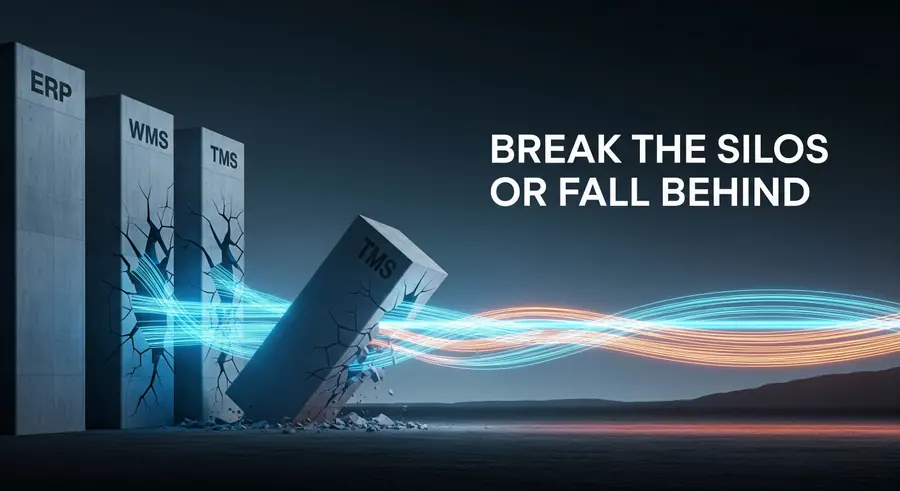
Cash
Break the Silos: The Handoffs Between ERP, WMS and TMS That a Person Still Performs
Three systems each hold part of the same order and none holds the whole of it, so the joins are made manually. The cost is not licence spend. It is the processing lag those joins add to every line.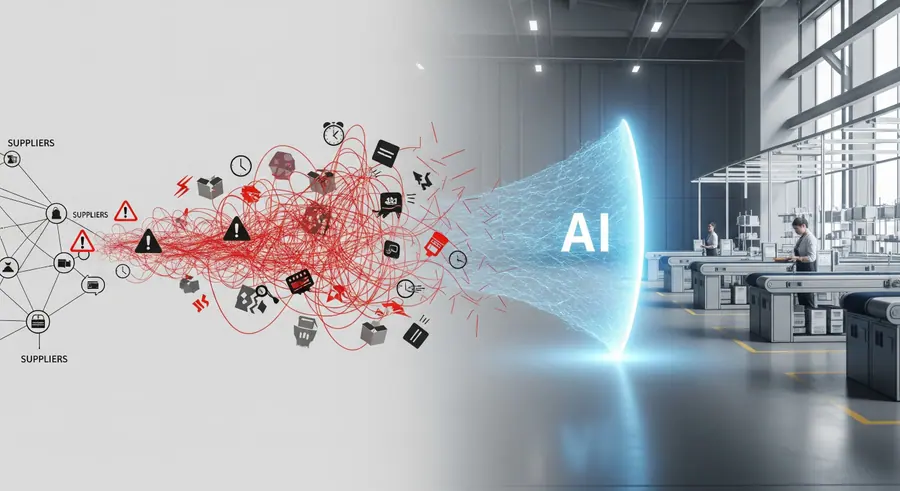
Cash
The Supplier Latency Trap: A Vendor Portal Nobody on Either Side Trusts
Lead times, component substitutions and purchase confirmations are reconciled by email and re-keyed twice. Every hour of that reconciliation is an hour the buffer inventory exists to cover.
Profit
The Tariff Position: A Landed Cost That Moves Faster Than Your Price List
Duty exposure now changes inside a quarter while bills of material and price lists change annually. The gap between the two is absorbed as gross margin, and no single function is asked to report it.
Throughput
Navigating Uncertainty: You Learn a Supplier Is Late When the Line Stops
Disruption is visible upstream days before it reaches the plant, but the signal arrives through a person rather than a system. What is lost in that interval is schedule, not information.
Throughput
The Fulfillment Leak: Goods That Beat Their Schedule and Then Wait for a Slot
Finished product arrives at the dock on time and queues for waves, slots and tenders. Throughput won on the floor is surrendered in the yard, invisible to OEE and fatal to OTIF.
Throughput
The Headcount Paradox: Multiplying Supply Chain Yield Under Frozen Budgets
Logistics volume scaled and the back office scaled with it, because everyone assumed it had to. Most of the added administrative load is handoff work, not judgement work.
Cash
The Data Cleansing Trap: The Cleanup Project That Postpones the Return
The premise that records must be clean before anything can be automated has cost more programs than bad data ever did. Most of what a cleansing project fixes can be resolved in transit instead.
Cash
The $10M ERP Decision: Why Core Replacement Underperforms an Orchestration Overlay
Why multi-million dollar system migrations underperform, and what deploying an agentic abstraction layer recovers instead, without core replacement risk.Start with a number, not a read.
Everything here works from a figure produced against your own records in seven days. That is the cheapest way to find out whether any of it applies to you.