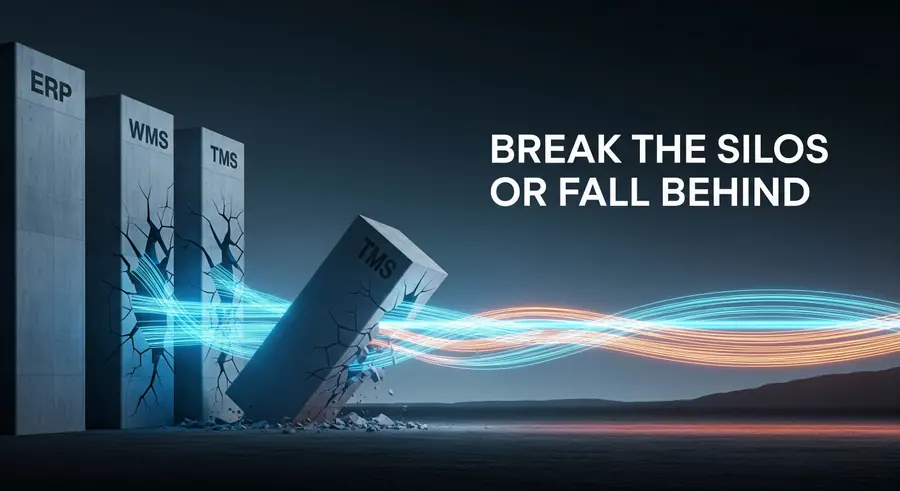
During peak quarter, the central order system fails. The cause is a single undocumented point-to-point script that has not held against a transaction volume spike. Because legacy ERP, WMS, and custom fulfillment portals are connected by hard-coded integrations, the failure propagates: inventory visibility is lost, warehouses ship without confirmation, and cancellations accumulate at the service desk while engineering traces which connection broke.
This is the recurring cost of a fractured software estate. Custom code has been written each time two systems needed to exchange data. This integration method holds up to 85% of enterprise IT budget in maintenance loops, leaving no capital for optimization. When a volume spike or trade shock arrives, the resulting data congestion can produce total system failure.
Architectural comparison
| Fragile system overhead | Orchestration layer |
|---|---|
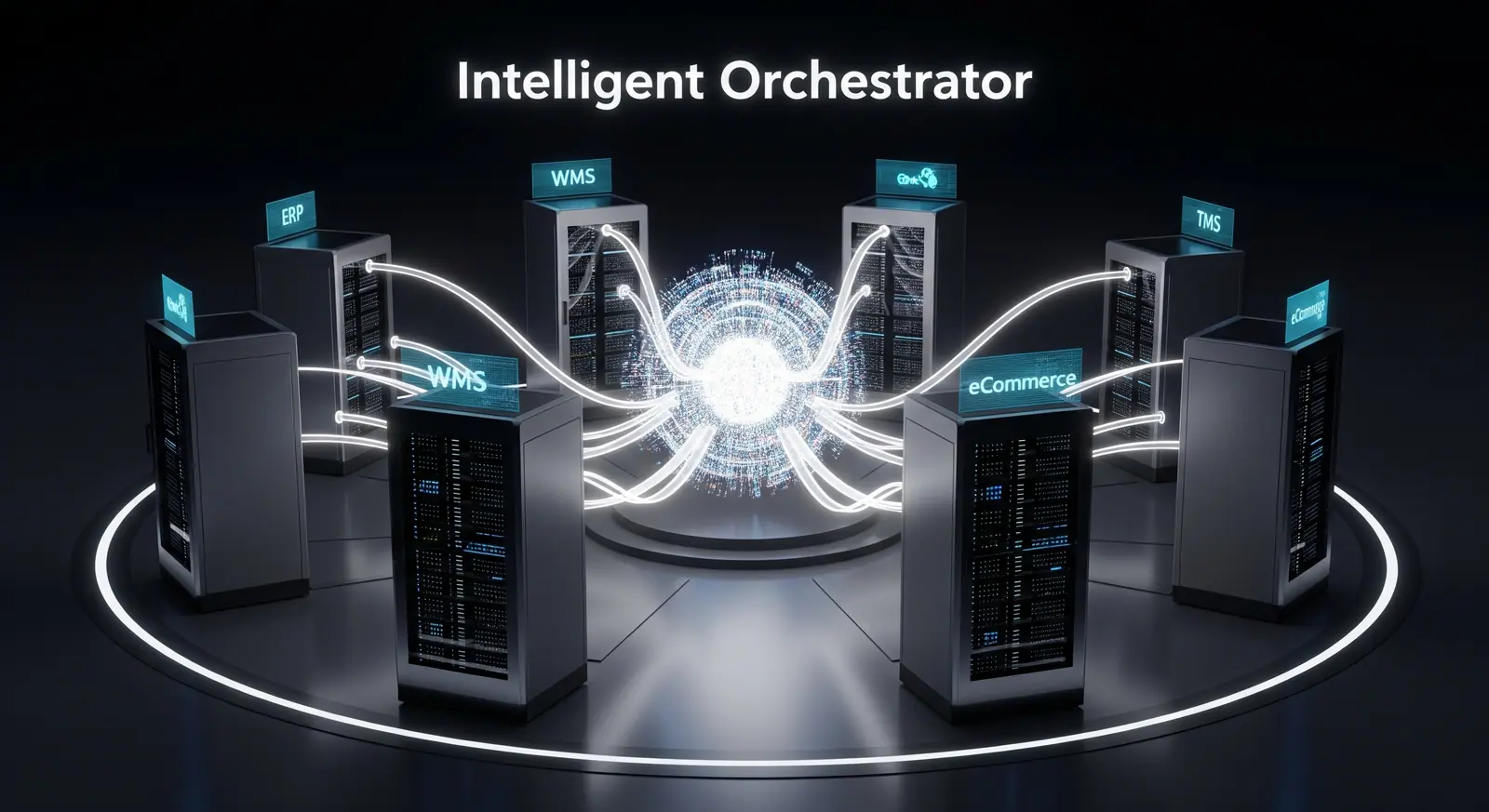
| Dozens of rigid custom connections; modifying one database table risks breaking downstream fulfillment tools | A middleware layer unifies data without altering underlying tables, reducing error points by 30% |
| Systems pass updates in scheduled batch drops, forcing logistics to plan against historical data | Event-driven pipelines stream logs across endpoints instantly, compressing order-to-cash loops by an average 20% |
Three systems each hold part of the order. None holds the whole of it, so a person becomes the join.
The visibility consequence
The maintenance burden of point-to-point scripts is the visible cost. The structural cost is that transactional tables remain isolated: forecasting models cannot sense demand shifts, and logistics coordinators cannot defend delivery targets. An event-driven overlay that gathers, normalizes, and distributes transaction updates across endpoints keeps the estate synchronized without a rewrite.
Verified system outcome
Facing cross-platform tracking lag, a logistics provider deployed a non-invasive semantic overlay above its legacy ERP and WMS databases rather than commissioning additional custom scripts. Within a 60-day implementation window, the network eliminated 85% of its custom engineering backlog, producing a 20% expansion in net operational capacity and protecting high-volume targets without system downtime.
Integration is not the same as orchestration. The first connects systems; the second governs what happens between them.