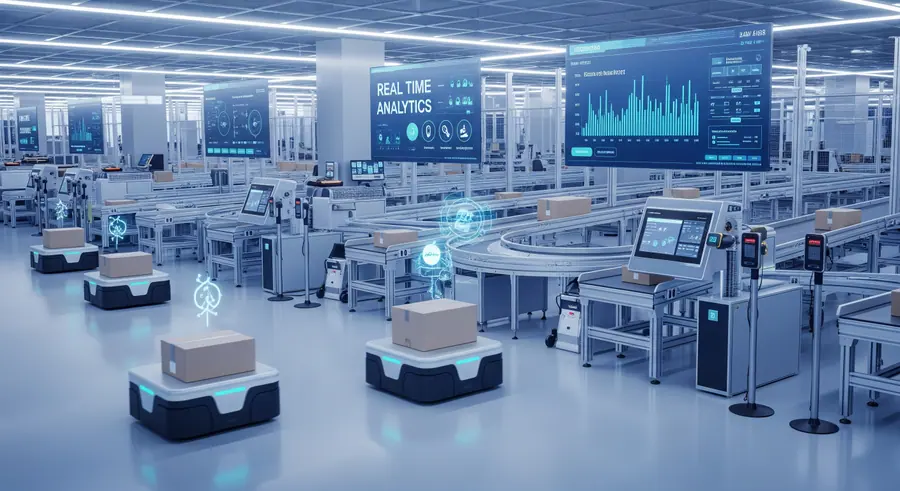
Distribution facilities are not passive storage nodes. They are the point at which fulfillment margin is either preserved or forfeited, and every mis-picked line, processing lag, and manual entry step carries a measurable capital cost. 70% of enterprise warehouses continue to operate on manual workflows or fragmented application systems.
Structural fragmentation holds capacity
Where intralogistics platforms remain un-synchronized, localized floor friction compounds into enterprise margin erosion. Manual pick sequences, labeling errors, and lagging replenishment protocols generate quality exceptions averaging $39 of capital loss per mis-picked order line, against an industry baseline of one error per 100 manual shipments. Because legacy ERP, WMS, and TMS systems operate on disjointed batch cycles rather than continuous events, 60% of distribution facilities identify platform integration as their single greatest productivity constraint. Against a systemic 40% warehouse labor turnover rate, the manual configuration produces an unpredictable cost base.
Warehouse performance is no longer set by individual material handling assets. It is set by the layer capable of orchestrating them in real time.
The orchestration pipeline
Stage 01, Multi-system synchronization. A non-invasive integration layer is established above legacy WMS, ERP, TMS, and physical IoT and robotics configurations. Unifying cross-platform communication produces a 25% increase in baseline volume throughput and removes manual reconciliation delay.
Stage 02, Algorithmic exception routing. Real-time decisioning applied to active fulfillment steps drives a 30% reduction in physical picking errors. Optimizing travel paths, putaway, and replenishment routing compresses total warehouse labor cost by 18% without altering headcount.
Stage 03, Demand-tuned replenishment. Predictive inventory tracking enables high-velocity replenishment, producing a 20% reduction in warehouse carrying costs and releasing working capital while protecting service lines against downstream supply variance.
The cost of deferral
Fulfillment overhead has risen 20% over recent execution cycles, and 79% of operations executives are accelerating automation investment in response. Elite throughput does not require a multi-million-dollar robotics overhaul; an event-driven orchestration layer above the existing WMS, ERP, and material handling nodes avoids rip-and-replace exposure entirely.
Verified system outcome
A regional distribution network deployed an event-driven orchestration layer and automated 50% of core workflows, including putaway, replenishment, and exception handling. Within a 60-day implementation window, the hub recorded a 31% acceleration in order processing velocity, a 23% increase in net fulfillment accuracy, and an 18% reduction in direct operational labor cost.
Static, reactive software was not architected for current demand variability or labor availability. Moving from flat dashboards to algorithmic decision engines raises final order execution accuracy to a 99.9% baseline. With 75% of enterprise networks scaling automation capital, and ABI Research projecting 75% adoption of advanced robotics frameworks by 2027, sustained intralogistics fragmentation is a quantifiable risk position.